
How to Check Huroob in Absher: Huroob Status Check in Saudi Arabia
Huroob is a common term for an absence-from-work report involving an expatriate worker in Saudi Arabia. Many residents search for ways to check their Huroob status through Absher.
However, the current government process needs a clear distinction. Absher and Qiwa serve different purposes. Absher provides several residency and passport services, including absence-related services.
For private-sector expatriate workers, the Ministry of Human Resources and Social Development (MHRSD) provides an official Expatriate Employee Inquiry through Qiwa. Employers can use it to check a worker’s status and verify whether the worker remains on the job.
The inquiry accepts details such as the Iqama number, border number, passport number, and nationality.
Checking your current status can help you understand your employment record before taking further action. It can also help you avoid relying on outdated Huroob instructions or unofficial websites.
In this guide, you will learn how Huroob-related status checks work, which platform applies, and what each status means.
Quick Answer: How to Check Huroob in Absher
- Huroob is a common term for an absence or absconding report involving an expatriate worker.
- For private-sector expatriate employment status, MHRSD provides an official inquiry through Qiwa. Employers can use it to check a worker’s current status.
- The inquiry can use the worker’s Iqama or residence permit number, border number, passport number, and nationality.
- Absher provides separate residency and absence-related services. These services should not be confused with the MHRSD employment-status inquiry.
- An Iqama validity check is different from checking an employment or absence status. A valid Iqama does not by itself confirm the worker’s employment status.
What Does Huroob Mean in Saudi Arabia?
Huroob (هروب) is a common term people use for an absence or absconding report involving an expatriate worker. In current Saudi employment procedures, government sources use terms such as “absence from work” and “Absent from Work.”

Many expatriates still search for “Huroob” because the term remains widely recognized. However, the terminology used in official systems can differ. For example, MHRSD procedures describe an employer’s request as a report of “absence from work.” The worker’s status then becomes “Absent from Work” in the Ministry’s systems.
This difference matters when you check your status online. A search for “Huroob” may lead you to Absher, Qiwa, or MHRSD. Each platform serves different government functions.
| Search term | Meaning or context |
| Huroob | Common term used by expatriates |
| Absence from work | Term used in employment procedures |
| Absent from Work | Worker status used in MHRSD systems |
| بلاغ هروب | Arabic term for a Huroob or absconding report |
| بلاغ تغيب | Arabic term for an absence report |
| متغيب عن العمل | Arabic term meaning absent from work |
In this guide, we use Huroob because it matches the search term. We also use the current government terminology to keep the information accurate and clear.
Does Absher Have a Huroob Status Checker?
Many people search for “Huroob check in Absher”, but the current Absher service directory does not list a dedicated Huroob Status Inquiry service. Its Passport Services include related options such as Query Border Number, Query Resident Report, and Reporting Domestic Workers’ Absence from Work.
This distinction matters because Huroob can refer to an employment-related absence status. For private-sector expatriate workers, the Ministry of Human Resources and Social Development (MHRSD) provides the official Expatriate Employee Inquiry through Qiwa. That service helps employers check an expatriate worker’s employment status.
Absher still plays an important role in residency and Passport-related services. For example, it provides Resident ID expiry inquiries and resident report inquiries. It also offers absence reporting for domestic workers.
Therefore, do not follow an old article that gives an unverified Absher menu path for Huroob. Government services can change as platforms are updated.
The safest approach is to identify what status you need to check first. Then use the official Saudi platform that handles that service. This avoids confusing an Iqama check with an employment-status inquiry.
How to Check Expatriate Worker Status Online
For a private-sector expatriate worker, use the official MHRSD employment inquiry through Qiwa when you need to verify employment status. MHRSD identifies this service as the Expatriate Employee Inquiry. It helps employers check an expatriate worker’s status and whether the worker remains on the job.
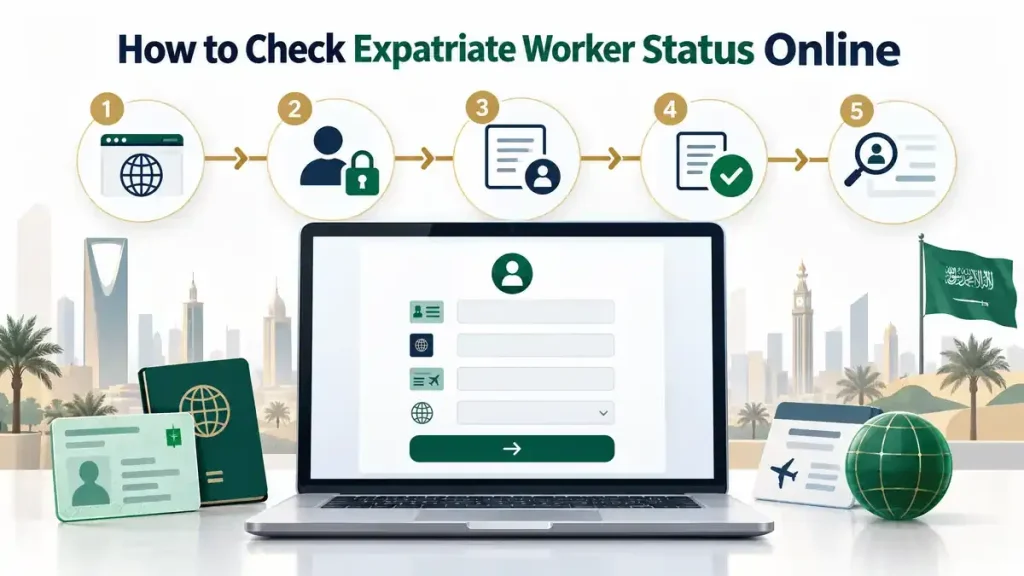
Step 1: Open the Official Service
Go to the official MHRSD service or its Qiwa channel. Avoid third-party websites that ask for your personal information.
Step 2: Sign In
Use the applicable Qiwa account for the employer or establishment. The service focuses on checking an expatriate employee’s registered employment status.
Step 3: Enter Worker Information
MHRSD lists several identifiers for the inquiry. These include:
- Border number
- Residence permit or Iqama number
- Passport number
- Nationality
Use the information that the official service requests for the worker.
Step 4: Submit the Inquiry
Review the details before submitting the request. The system then processes the inquiry using its current records.
Step 5: Review the Worker Status
Check the result shown by the official service. The inquiry helps employers verify the expatriate worker’s registered status and whether the worker remains on the job.
Important: Use only official Saudi government platforms when entering an Iqama number, passport number, or other personal information. Avoid unofficial Huroob-check websites that request sensitive details.
Information Required for Huroob or Worker Status Inquiry
You may need specific worker details to complete an Expatriate Employee Inquiry. MHRSD lists the residence permit number, border number, passport number, and nationality among the information used for the inquiry.
| Information | Purpose |
| Iqama or residence permit number | Identifies the expatriate worker |
| Border number | Provides an alternative worker identifier |
| Passport number | Provides another identification option |
| Nationality | Helps identify the worker’s record |
Keep the information accurate before submitting the inquiry. A wrong number or incorrect nationality can prevent you from finding the correct worker record.
You do not need to enter every identifier if the official service requests a specific combination. Follow the fields shown on the current MHRSD or Qiwa service.
Tip: Never share your Iqama, passport details, or account credentials with unofficial Huroob-check websites. Use official Saudi government platforms for status inquiries.
How to Check Huroob by Iqama Number
If you want to check Huroob by Iqama number, use the official expatriate employee inquiry. MHRSD lists the residence permit number as one of the identifiers for this service.
Follow these steps:
- Open the official MHRSD or Qiwa employment inquiry service.
- Enter the worker’s Iqama or residence permit number.
- Provide any other details requested by the official service, such as nationality.
- Submit the inquiry after checking the information.
- Review the worker’s current employment status shown by the service.
The Iqama number helps identify the worker’s record. The Iqama itself does not display a Huroob status. The relevant government inquiry checks the worker’s employment record using the available identifiers.
MHRSD describes this service as an inquiry for checking an expatriate employee’s status and whether the worker remains on the job.
If the result does not match your situation, do not rely on an unofficial Huroob checker. Verify the record through the appropriate Saudi government service.
Can You Check Huroob by Passport Number?
You can use a passport number as an identifier in the official expatriate employee inquiry. MHRSD lists the passport number among the details used to identify an expatriate worker.
To check Huroob by passport number, use the official MHRSD employment inquiry through the applicable Qiwa service. Enter the worker’s passport number and provide any other details the service requests. Then submit the inquiry and review the worker’s employment status.
The passport number helps locate the worker’s record. It does not mean that the passport itself shows a Huroob status.
Also, do not assume that every public Absher inquiry accepts a passport number. Absher and Qiwa provide different government services. Use the platform that matches the status you want to verify.
If the official service does not return a result, check the entered details carefully. Avoid third-party websites that request passport information for a Huroob check.
Can You Check Huroob by Border Number?
You can use a border number to identify an expatriate worker in the official MHRSD employee inquiry. MHRSD lists the border number among the identifiers available for checking an expatriate employee’s status.
To check Huroob by border number, open the official MHRSD employment inquiry through the applicable Qiwa service. Enter the worker’s border number and provide any other requested details. Submit the inquiry and review the employment status shown in the result.
The border number identifies the worker’s record. It does not mean that the border number itself displays a Huroob status.
If you cannot find the worker, check the border number carefully. Also verify any other information the service requests.
Do not use unofficial websites that promise a Huroob status check by border number. These sites may request sensitive worker information without providing an official government service. Use the current MHRSD or Qiwa service instead.
What Does “Absent From Work” Mean?
“Absent From Work” is an employment status used in Saudi Arabia’s labor system. Many expatriate workers call this status Huroob because that term remains common in everyday searches.
However, these terms can describe different parts of the same process. MHRSD’s procedural guide explains that an employer can submit an absence-from-work report for an employee who meets the applicable conditions. After the report, the worker’s status becomes “Absent from Work” in the Ministry’s systems.
Understanding these terms helps you read your status correctly:
| Term | What it refers to |
| Huroob | Common term used for an absence or absconding report |
| Absence report | An employer’s report that an employee is absent from work |
| Absent from Work | A worker status recorded in the Ministry’s systems |
| Work interruption | A specific employment process that can follow an absence situation |
The term Huroob appears frequently in searches because workers and employers have used it for years. Current government procedures often use absence fromwork instead.
This distinction matters when checking your employment status. Searching for “Huroob” may lead you to older instructions or unofficial websites. The official MHRSD terminology gives you a clearer way to understand the result.
If your record shows Absent from Work, do not assume that your Iqama has expired. An employment status and Iqama validity are separate matters. Check each status through its relevant government service.
Is “Absent From Work” the Same as Huroob?
Huroob is the common term many people use when discussing an expatriate worker’s absence report. Current Saudi employment procedures use more specific terms, including “absence from work” and “Absent from Work.” MHRSD’s procedural guide uses these terms when describing the absence-report process.
For this reason, you may see Huroob in searches while seeing Absent from Work in an official employment system. The terms relate closely, but you should not treat every historical Huroob case as identical to every current absence procedure.
| Term | Where users may encounter it |
| Huroob | Common search term |
| Absence from work | Employment procedures |
| Absent from Work | Worker status |
| Work interruption | Specific employment procedure |
| بلاغ تغيب | Arabic absence-report terminology |
This distinction helps when you check your worker status online. An article may call the process a Huroob check, while the official service may use different wording.
It also explains why older guides can look different from current government services. Saudi employment platforms and procedures can change over time.
When checking your status, focus on the current government record and terminology. Do not rely only on an older Huroob guide or a third-party website. This approach gives you a clearer view of your actual employment status.
Huroob vs Iqama Validity
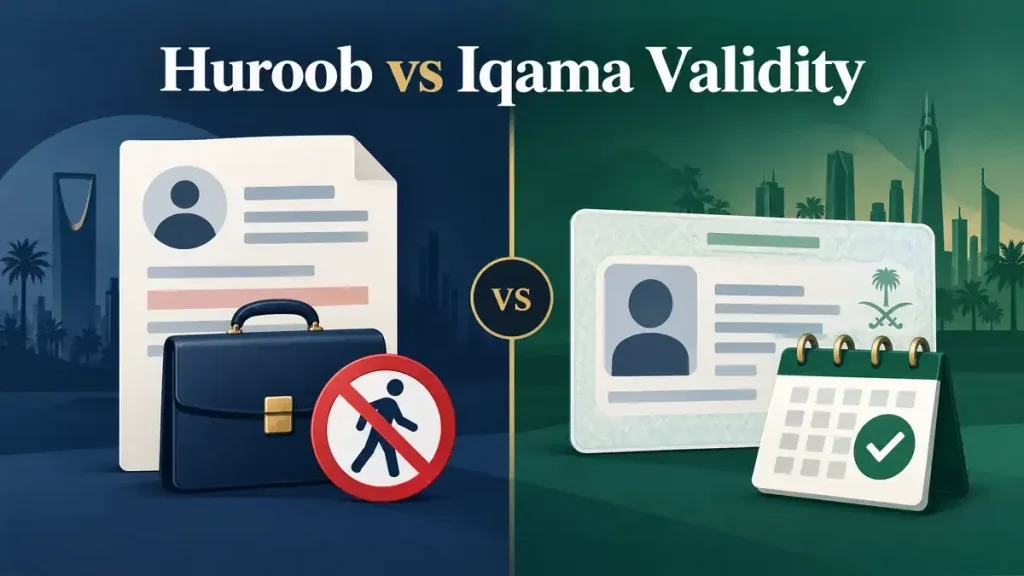
Huroob and Iqama validity are not the same thing. They relate to different parts of a resident worker’s record.
Iqama validity concerns the status and expiry date of the Resident ID. Absher provides an official service to check whether a Resident ID is active or expired.
Huroob, commonly linked with an absence-from-work status, concerns an employment record. MHRSD’s procedural guide explains that an absence report can change the worker’s status to “Absent from Work” in the Ministry’s systems.
| Huroob or absence status | Iqama validity |
| Employment or absence issue | Residency-document validity |
| Relates to worker status | Relates to Resident ID |
| MHRSD and Qiwa may handle the employment side | Absher provides Iqama validity inquiries |
| May affect employment procedures | Shows whether the Iqama is active or expired |
A worker can therefore have an active Iqama while facing an employment-status issue. You should check both records when investigating a problem.
Do not assume an expired Iqama means Huroob. Likewise, do not assume a valid Iqama proves that no absence status exists.
For accurate results, use the relevant official service for each status. This distinction can prevent confusion when checking Huroob, employment status, or Iqama validity.
Absher vs Qiwa vs MHRSD: Which Platform Should You Use?
Saudi government platforms handle different types of services. This can make Huroob status checks confusing. The key is to use the platform that matches your specific need.
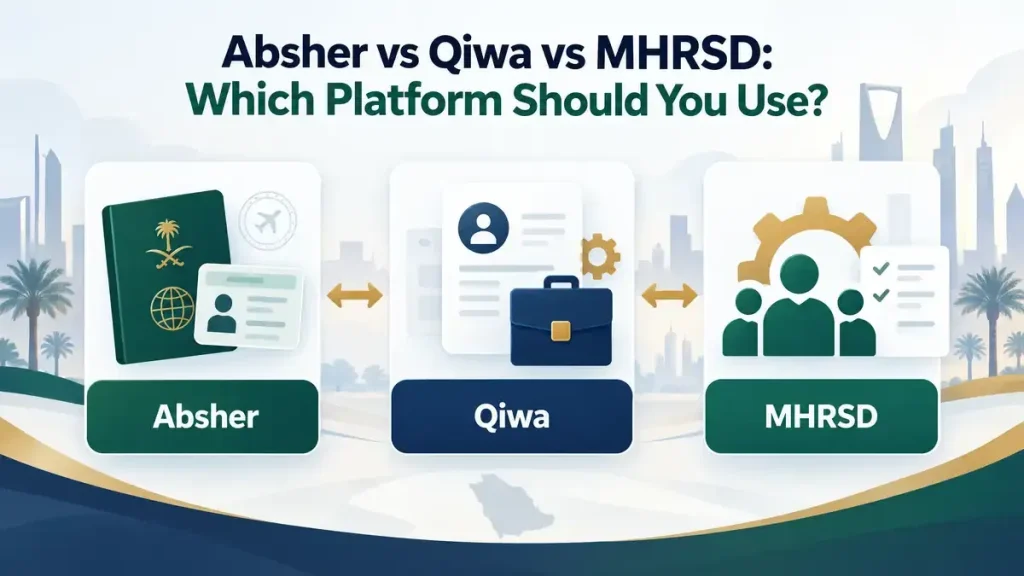
| Platform | Main relevance |
| Absher | Residency, passport, and related government services |
| MHRSD | Employment and workforce regulations and services |
| Qiwa | Employment and workforce services |
| Jawazat / MOI | Residency and immigration matters |
Absher
Absher provides many services related to residents, passports, and residency documents. Its current service directory includes resident inquiries, border-number inquiries, and absence-reporting services.
However, the directory does not list a dedicated Huroob Status Inquiry under that name. This is why you should avoid relying on old Absher menu instructions.
MHRSD
The Ministry of Human Resources and Social Development (MHRSD) handles employment and workforce matters. Its official Expatriate Employee Inquiry helps employers check an expatriate worker’s employment status.
Qiwa
Qiwa serves as the digital platform for many MHRSD employment services. MHRSD identifies Qiwa as the channel for its expatriate employee inquiry.
Jawazat and MOI
The General Directorate of Passports (Jawazat) operates under the Ministry of Interior. Its services focus on residency, passports, and immigration matters.
Therefore, do not treat Absher, Qiwa, and MHRSD as interchangeable platforms. If you want to check an expatriate worker’s employment status, start with the official MHRSD/Qiwa service. Use Absher for the residency or passport service you actually need. This distinction helps you avoid outdated Huroob instructions and incorrect status checks.
Huroob for Private-Sector Employees
For private-sector expatriate workers, an absence-from-work report follows a specific MHRSD process. The employer can submit the request through the relevant Qiwa service when the worker meets the stated conditions.
MHRSD’s procedural guide states that the worker must have been absent without a legitimate reason for either:
- More than 30 days during the contractual year, or
- More than 15 consecutive days.
The procedure also includes other requirements. For example, the worker’s status must show as employed, and the work permit must remain valid for at least 60 days. The organization must also have an active status.
After an absence report, the worker’s employment status can change to “Absent from Work” in the Ministry’s systems.
Rules can change, so avoid relying on old Huroob guides. MHRSD has introduced newer work-discontinuation measures and correction initiatives through Qiwa.
If you need to verify a worker’s current status, use the official MHRSD/Qiwa service. Do not assume that every absence case follows the same outcome. The worker’s category, report date, and applicable procedure can affect the available options.
Huroob and Absence for Domestic Workers
Domestic workers follow a different process from private-sector employees. Absher provides an official “Reporting Domestic Workers’ Absence from Work” service for this category.
Citizens and residents can use the applicable Absher service when they meet its requirements. The official Absher guide states that the user must have a registered and activated Absher account. It also lists conditions for the domestic worker and the absence report. These include having a valid Iqama and no existing valid absence notification for the same absence.
This process differs from the employment-status inquiry used for private-sector expatriate workers. Do not automatically apply Qiwa instructions to domestic workers.
| Private-sector worker | Domestic worker |
| Employment status relates to MHRSD procedures | Absence reporting is available through Absher |
| Qiwa may handle the relevant employment service | Absher provides the domestic-worker absence service |
| Employment rules and procedures apply | Domestic-worker service conditions apply |
If you are dealing with a domestic worker, check the current Absher service requirements before submitting an absence report. Government services can change, so older guides may contain outdated steps.
Also, an absence report and a status inquiry are not the same action. One records an absence, while the other helps you verify a worker’s current record. Use the official service that matches your purpose.
What Happens After an Absence-From-Work Report?
After an employer submits an absence-from-work report, the worker’s status can change in the Ministry’s systems. The applicable MHRSD procedure gives the worker a 60-day period for specific actions. During this period, the system may allow the worker to transfer to another employer or request a final exit, subject to the stated conditions.
The procedural guide explains two main options:
- Transfer to another employer: A new employer starts the transfer request through the applicable system. The worker must approve the request, followed by the required Ministry processing.
- Final exit: The worker can issue a final exit visa through their Absher account during the applicable period.
The 60-day period does not mean every Huroob case automatically receives the same treatment. It applies to the specific MHRSD work-interruption and absence procedure, along with its conditions.
The official guide also states that failure to transfer or leave within 60 days can cause the system to reject both options. The worker’s “Absent from Work” status can then remain in the Ministry’s connected systems.
Because Saudi employment procedures can change, check the current MHRSD or Qiwa rules before taking action.
Can Huroob Affect Transfer to a New Employer?
A worker’s employment status can affect whether a transfer to a new employer can proceed. The transfer process follows current MHRSD rules and conditions.
MHRSD provides the Employee Transfer service through Qiwa. The service allows employers to request the transfer of non-Saudi workers from another employer.
The worker’s record must meet the conditions required by the applicable transfer process. An Absent from Work status can therefore affect the available transfer options. However, you should not assume that every Huroob case has the same outcome.
The Saudi National Platform also lists expatriate worker transfer as an MHRSD service. The service can require the worker’s Iqama number during the transfer process.
Current rules can also provide specific routes for some workers. For example, MHRSD describes transfer services that operate under defined regulations and conditions.
If your status shows an absence or work-interruption issue, check the current Qiwa and MHRSD requirements. Do not rely on forum posts or agents who promise guaranteed transfer.
Your eligibility depends on the current government record and applicable conditions, not simply the fact that someone calls the case “Huroob.”
What If the Huroob Report Is Wrong?
If your status shows Absent from Work but you believe the report is incorrect, verify the record before taking further action.
If Your Status Appears Incorrect
- Verify the status first. Check the current result through the applicable official MHRSD or Qiwa service.
- Save the result and date. Keep a screenshot or other record showing the status and when you checked it.
- Review your employment records. Check your contract, attendance records, salary payments, and other relevant documents.
- Check your Qiwa information. Look for incorrect employment or contract details that may relate to the issue.
- Contact MHRSD through an official channel. The Ministry provides channels for inquiries, complaints, and beneficiary support.
- Keep supporting evidence. Store documents that show your actual employment situation and communications with your employer.
- Use the applicable dispute or complaint channel. The correct route depends on the facts and the worker’s case.
MHRSD’s procedure states that an absence report can change the worker’s status to “Absent from Work.”
Do not assume that contacting the sponsor will automatically remove the report. The available remedy depends on the case and current MHRSD rules.
Avoid agents who promise guaranteed Huroob removal for a fee. Use official government channels and keep your records throughout the process.
How to Resolve or Remove Huroob
Many workers search for how to remove Huroob, Huroob removal, or cancel Huroob. However, Saudi Arabia does not have one universal “Remove Huroob” button for every case.
The correct route depends on several factors. These include the worker category, report date, employment status, and applicabble MHRSD procedure.
For some professional workers, MHRSD provides specific routes to correct an Absent from Work status. One current initiative through Qiwa allows eligible workers to transfer legally to a new employer. The initiative covers several absence and contract-related cases. It also includes specific eligibility conditions.
Another MHRSD procedure provides a 60-day period for certain reported workers. During that period, applicable workers may transfer to another employer or complete final exit. If neither action occurs within the stated period, the system can keep the worker’s status as absent from work.
Therefore, do not rely on websites claiming they can “cancel Huroob” instantly.
First, identify your current status and worker category. Then check the applicable MHRSD or Qiwa procedure. If your case involves an incorrect report, use the official complaint or support channel. MHRSD provides official channels for inquiries and complaints.
The available solution depends on the specific government record and current rules. It does not depend on the term “Huroob” alone.
Beware of Huroob Removal Scams
Huroob problems can create pressure when a worker faces a blocked transfer or employment issue. That pressure can attract people who promise fast Huroob removal for money.
Recent user discussions on Reddit describe workers paying agents thousands of riyals without getting the promised result. Other workers report transfer problems linked to an Absent from Work status.
Warning: Never give your Absher password, OTP, Nafath approval, or sensitive identity credentials to anyone promising to remove Huroob.
Be careful with anyone demanding a large upfront payment to “clear” a government status. An agent cannot guarantee the outcome of an official government procedure.
Always verify your status through the relevant MHRSD, Qiwa, Absher, or other official channel. Keep copies of your employment records and official case information.
If someone claims they can remove Huroob instantly, ask for the official government procedure and service name. Do not share account credentials to prove your identity.
Use official channels for complaints, support, and status correction. This protects your information and gives you a verifiable record of your request.
Huroob Check Not Working
If your Huroob check does not show the expected result, first confirm that you are using the correct government service. MHRSD provides an expatriate employee inquiry through Qiwa. The service uses identifiers such as the Iqama, border number, passport number, and nationality.
| Problem | What to check |
| Worker not found | Verify the Iqama, border number, passport number, and nationality. |
| Absher doesn’t show Huroob | Check the relevant MHRSD or Qiwa employment status instead. |
| Iqama is valid but status is different | Remember that Iqama validity and employment status are separate checks. |
| Old MOL instructions don’t work | Use current MHRSD and Qiwa services instead of outdated Ministry of Labor instructions. |
| Domestic worker | Use the applicable Absher domestic-worker service and its current conditions. Absher lists a dedicated absence-reporting service. |
| Transfer blocked | Check the worker’s employment status and current Qiwa transfer requirements. |
Do not assume that an error means your status has changed. Recheck the information and use the official platform for your worker category.
For Absher-related technical problems, you can also use its official support and complaint channels.
If the issue concerns an employment status, focus on the MHRSD/Qiwa record rather than relying on an unofficial Huroob checker.
Common Mistakes When Checking Huroob
A Huroob check can give confusing results when you use the wrong service or outdated information. Avoid these common mistakes:
- Using unofficial websites: Use official Absher, MHRSD, or Qiwa services. Avoid sites that request sensitive account details.
- Confusing Iqama expiry with Huroob: Iqama validity and employment status are separate checks. A valid Iqama does not confirm your employment status.
- Using old MOL instructions: Older Ministry of Labor instructions may no longer match current procedures. MHRSD now provides relevant expatriate employee inquiries through Qiwa.
- Mixing worker categories: Domestic workers and private-sector expatriate employees can follow different procedures. Do not apply one process to every worker.
- Giving credentials to agents: Never share your Absher password, OTP, or Nafath approval with someone offering Huroob removal.
- Treating forum comments as official rules: Forums can describe personal experiences, but government rules can change. Verify important information through official sources.
If your Huroob status is not showing, check the correct MHRSD or Qiwa service before assuming the status has changed.
FAQs About Checking Huroob in Saudi Arabia
Can I check Huroob directly in Absher?
Absher does not currently list a dedicated general Huroob status checker. For private-sector expatriate employment status, MHRSD provides an expatriate employee inquiry through Qiwa.
How can I check Huroob by Iqama number?
Use the applicable MHRSD expatriate employee inquiry. Enter the worker’s Iqama number and other requested details. The service also supports other identifiers.
Can I check Huroob by passport number?
Yes, MHRSD lists the passport number as an identifier for its expatriate employee inquiry. You may also need the nationality and other requested information.
Can I check Huroob by border number?
Yes. MHRSD’s expatriate employee inquiry accepts the worker’s border number. Use the official Qiwa service rather than an unofficial checker.
What does “Absent From Work” mean?
“Absent from Work” describes an employment status used in MHRSD procedures. An employer can submit an absence report when the applicable conditions exist.
Is Huroob the same as absent from work?
Huroob is a common term that people use for an absence or absconding report. Current MHRSD procedures use terms such as “absence from work” and “Absent from Work.” The exact legal procedure depends on the case.
Is Huroob the same as an expired Iqama?
No. Iqama validity and employment status are separate checks. Absher provides a separate inquiry for Resident ID validity and expiration.
Can Huroob affect job transfer?
Yes, an absence status can affect transfer options. MHRSD procedures provide specific transfer routes for eligible reported workers. Current transfer services also operate through Qiwa and MHRSD rules.
Can I transfer to another employer?
Some workers can transfer under specific MHRSD procedures. For certain absence cases, the worker may transfer during the applicable 60-day period. Eligibility depends on the worker’s record and current rules.
Can I leave Saudi Arabia with an absence status?
Certain MHRSD procedures allow eligible workers to issue a final exit during the applicable period. The procedural guide describes final exit as one available option in qualifying cases.
Can I return to Saudi Arabia after Huroob?
Do not assume that a previous absence status guarantees or prevents future entry. Return eligibility depends on the worker’s immigration record, departure circumstances, and applicable Saudi rules.
How can I challenge an incorrect Huroob report?
First, verify the current status and save evidence showing the result. Review your employment records and Qiwa information. Then use the applicable MHRSD complaint or support channel.
How do I check domestic worker absence?
Domestic-worker procedures differ from private-sector employment procedures. Absher provides a specific Reporting Domestic Workers’ Absence from Work service.
Why can’t I find my worker’s status?
Check that the Iqama, border number, passport number, and nationality match the official record. Also confirm that you are using the correct service for the worker category. MHRSD’s expatriate inquiry is designed for employers.
Is the old MOL Huroob checker still used?
Do not rely on old Ministry of Labor instructions. MHRSD now provides the expatriate employee inquiry through Qiwa, while Absher handles separate residency and domestic-worker services.
Official Saudi Government Sources
For accurate Huroob and Absent from Work information, use primary Saudi government sources. The MHRSD Expatriate Employee Inquiry explains its purpose, beneficiaries, Qiwa channel, required identifiers, and immediate service duration.
- MHRSD: Expatriate Employee Inquiry and employment procedures.
- MHRSD: Procedural Guide for reporting worker absence.
- Absher: Passport Services, including domestic-worker absence reporting and Resident ID inquiries.
- MHRSD/Qiwa: Expatriate worker transfer services and requirements.
Always check the latest official guidance before taking action because employment procedures can change.