
Absher Services: The Ultimate Guide to Saudi Arabia’s Digital Government Platform
In the era of rapid digital transformation, Saudi Arabia has firmly established itself as a global leader in e-governance and digital public services. At the forefront of this technological revolution is the Absher Services platform, an official and comprehensive electronic portal launched by the Ministry of Interior in 2010. Absher (أبشر) has fundamentally revolutionized how citizens, residents, and visitors interact with the Saudi government, making once complex and time-consuming bureaucratic processes simple, fast, secure, and accessible from anywhere with an internet connection.
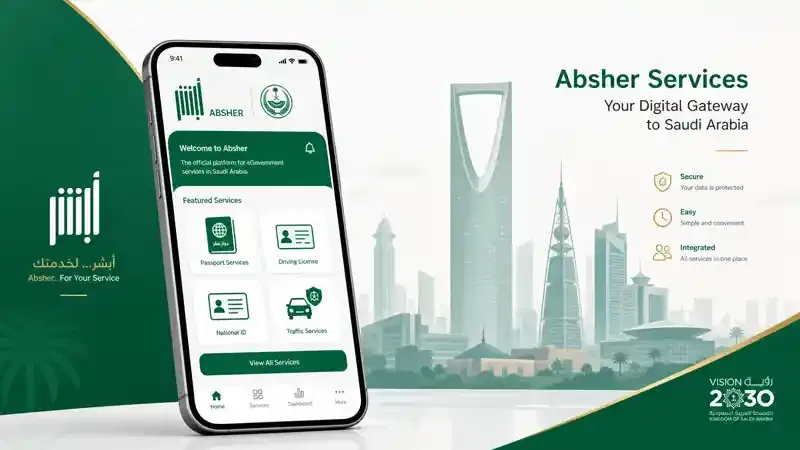
This comprehensive and in-depth guide explores everything you need to know about Absher Services, from its historical origins and core features to the detailed benefits it offers and the step-by-step process of registration and utilization. Whether you are a Saudi citizen looking to renew your national ID, an expatriate managing your residency (Iqama), or a business owner handling workforce management, this article will serve as your definitive, SEO-optimized resource. By understanding how to leverage Absher Services effectively, you can save significant time, reduce costs, and navigate the Kingdom’s administrative landscape with ease.
What Are Absher Services?
Absher Services is the unified digital gateway for the Saudi Ministry of Interior and its affiliated entities. The platform was designed with a clear mission: to provide government services digitally and in an integrated manner, leveraging modern technologies to deliver an excellent user experience with high reliability, security, and efficiency .
The name “Absher” is a colloquial term in the local Saudi dialect, indicative of glad tidings, good joyful news, or a speedy response to a request in the fullest sense . It represents Saudi Arabia’s first e-service platform, setting a benchmark for digital government initiatives across the region and inspiring similar projects in other Gulf Cooperation Council (GCC) countries.
Absher has become one of Saudi Arabia’s major digital government platforms, serving citizens, residents, and visitors through its electronic services. In 2025, Absher recorded more than 448 million electronic transactions, while the number of unified digital IDs issued through the platform exceeded 32 million.
The Three Pillars of Absher
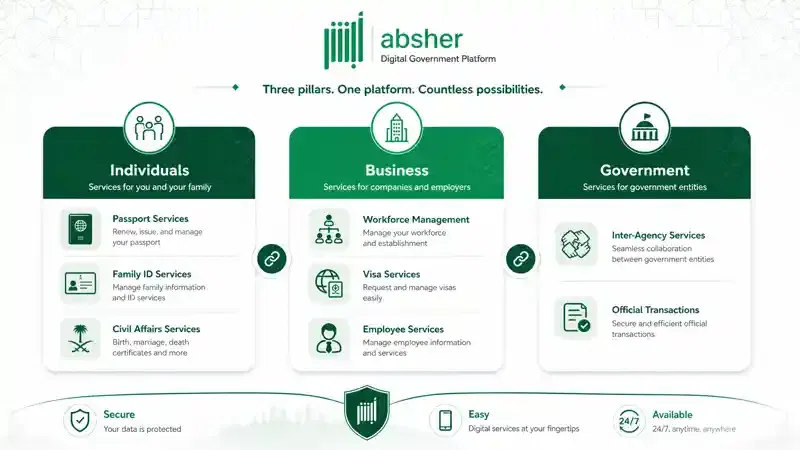
To cater to the diverse and evolving needs of its population and growing economy, Absher is divided into three distinct sub-platforms, each tailored to specific user groups:
| Platform | Target Audience | Primary Function |
| Absher Individuals | Citizens, Residents, Visitors | Access to personal services like residency renewal, passport issuance, driving license management, and civil affairs transactions. |
| Absher Business | Saudi Sole Proprietorships (up to 100 employees) | Management of workforce-related services, including visa issuance, residency renewals for employees, and domestic worker services. |
| Absher Government | Government Entity Employees | Facilitates official transactions between government bodies, streamlines inter-agency processes, and enhances internal government efficiency. |
The Absher platform accelerates and enhances the efficiency of electronic transactions, interlinks user data between entities to eliminate redundancy, and facilitates the implementation of governmental services with minimal paperwork . It is estimated that it takes only about three minutes to conduct an average service via Absher Services, and the platform saves an estimated SAR 15 billion annually in conventional transaction costs by reducing the need for physical offices and manual labor .
Key Services Offered by Absher
The sheer volume and variety of services available on Absher Services make it an indispensable tool for anyone living in or doing business in Saudi Arabia. These services are primarily categorized based on the government entities they serve, ensuring a structured and intuitive user interface.
1. Passport and Residency Services (Jawazat)
For expatriates and Saudi citizens traveling abroad, the passport and residency services are among the most utilized features on the platform. Absher enables users to manage these critical processes entirely online, eliminating the need for multiple visits to the General Directorate of Passports (Jawazat) offices.
•Residency Permit (Iqama) Management: Expatriates and their sponsors can renew residency permits annually, check their current validity status, and request replacement residency cards in case of loss or damage. This is particularly crucial for the millions of expatriate workers in the Kingdom, as maintaining a valid Iqama is a legal requirement.
•Visa Services: Users can issue exit and re-entry visas (both single and multiple trips), as well as final exit visas for employees or family members who are leaving the Kingdom permanently. The platform also allows for the cancellation of existing visas if plans change, providing flexibility and preventing unnecessary fees.
•Sponsorship and Family Management: Services include sponsorship transfers between employers, occupation changes on the residency permit, adding dependents (spouses and children) or newborns to the residency, and updating passport data to ensure it matches government records. These features help families stay together and maintain their legal status seamlessly.
•Passport Services: Saudi citizens can apply for the issuance and renewal of their passports through the platform, streamlining what used to be a complex bureaucratic process involving physical forms and long queues.
2. Civil Affairs Services (Ahwal)
The Ministerial Agency of Civil Affairs utilizes Absher Services to manage vital civil records for Saudi citizens, ensuring that the population’s legal documentation is always up to date and easily accessible.
•National ID Services: Citizens can renew their national IDs before expiration, request replacements for damaged or lost cards, and check their ID status to ensure it is valid for official transactions. The national ID is essential for banking, government services, and travel within the GCC.
•Family Records: The platform allows for the issuance and updating of family records, as well as verification of family members, which is often required for banking, employment, and other private sector services.
•Birth and Death Certificates: Parents can register newborns electronically and request birth certificates, reducing the administrative burden on new families. Similarly, death certificate issuance is handled through the system to assist families during difficult times, ensuring all legal procedures are completed efficiently.
•Electronic Delegation: Citizens can grant electronic power of attorney or delegation for various civil affairs transactions, allowing a trusted representative to handle paperwork on their behalf without compromising security or requiring physical presence.
3. Traffic Services (Muroor)
The General Department of Traffic has digitized a vast array of vehicle and driving-related services on Absher Services, making road safety and vehicle management more accessible to the public.
•Driving License Management: Citizens and residents can renew their driving licenses (available in 2, 5, or 10-year durations) and book, modify, or cancel training appointments at authorized driving schools. This ensures that all drivers are properly trained and licensed according to traffic regulations.
•Vehicle Registration (Istimara): Users can renew their vehicle registration and check the validity of their vehicle insurance, ensuring compliance with local traffic laws and avoiding penalties for expired documentation.
•Traffic Violations: Absher Services allows users to inquire about traffic violations, pay fines electronically, and submit appeals against unjustified penalties through a transparent and auditable system. This transparency helps build trust between the public and law enforcement agencies.
•Vehicle Ownership: The platform facilitates the transfer of vehicle ownership between individuals and the sale of vehicles through its electronic systems, reducing the potential for fraud and paperwork errors that were common in manual processes.
4. Absher Business Services
Absher Business is a specialized platform exclusively for Saudi sole proprietorships with no more than 100 employees. It is not available for larger companies or foreign investors directly, as those entities must use other government platforms like Qiwa or Muqeem. Key services include:
•Issuing visit visas for potential business partners, clients, or contractors, facilitating international business collaboration.
•Renewing employee Iqamas and issuing exit/re-entry visas to manage workforce mobility and ensure compliance with labor laws.
•Updating employee passport data and managing designated vehicle operators for company fleets, streamlining logistics and HR management.
•Issuing domestic worker visas and tracking overall employee data to ensure compliance with labor regulations .
5.Absher Service Fees and Payment Methods
While Absher Services itself is free to use, the government services requested through the platform require payment of standard fees. Understanding these fees and the payment process is essential for a smooth experience.
SADAD Payment System
All payments for Absher services are processed through the SADAD electronic payment system. This is a secure and widely used payment gateway in Saudi Arabia that connects government entities with banks.
Each government entity has a specific SADAD biller code:
| Entity | Biller Code | Related Services |
| Saudi Passports | 092 | Iqama renewal, exit/re-entry visas, sponsorship transfer, occupation change, adding dependents |
| Traffic Violations | 093 | Traffic violation fines, vehicle registration renewal |
| Ministry of Interior (Civil Affairs) | 096 | National ID renewal, damaged ID replacement, civil affairs late fees |
To pay for a service, users must first generate an invoice on Absher, which provides a unique invoice number. They can then use this number along with the appropriate biller code in their banking app, at an ATM, or via online banking to complete the payment. Invoice numbers are typically valid for 14 days.
Common Service Fees
The following are some of the most common service fees associated with Absher transactions:
•Issuing and renewing residency for company employees: SAR 650 per year.
•Professional individual residency renewal: SAR 600 per year.
•Single exit and re-entry visa (2 months): SAR 200, with an additional SAR 100 for each extra month.
•Multiple exit and re-entry visa (up to 3 months): SAR 500, with an additional SAR 200 for each extra month.
•Occupation change: SAR 1,000.
•First-time sponsorship transfer: SAR 2,000.
•Adding a dependent or newborn outside the Kingdom: SAR 2,000.
Note that these fees are subject to change by the respective government authorities, and users should always verify the latest fees on the official Absher website or the relevant entity’s website before making a payment.
5. Advanced Features and Digital Transformation
Absher is not just a static portal; it is a dynamic platform that continues to evolve with the latest technological advancements. Several advanced features highlight its commitment to innovation:
•Digital Wallet: The Absher app includes a Digital Wallet feature that allows users to store and access their official documents, such as their national ID or Iqama, electronically. This feature has seen massive adoption, with over 300 million document reviews conducted through it in 2024 alone .
•Self-Service Kiosks: To support users who may not have internet access or prefer physical interaction, the Ministry of Interior has deployed hundreds of self-service kiosks across the Kingdom. These kiosks allow users to register for Absher, activate their accounts, and perform various transactions without needing a smartphone or computer.
•Single Sign-On (SSO): As mentioned earlier, Absher acts as a central authentication hub. Once a user is logged into Absher Services, they can seamlessly access other major government platforms like Qiwa (for labor services), Mudad (for wage protection), and ZATCA (for tax and customs) without needing to log in again. This interoperability is a hallmark of a mature digital government ecosystem.
The Economic and Strategic Impact of Absher
The Absher platform is not just a convenience tool for the public; it is a cornerstone of Saudi Arabia’s Vision 2030. The ambitious national plan aims to diversify the economy, reduce reliance on oil, and foster a vibrant society with efficient, transparent, and accessible government services. Absher directly supports these goals by driving massive digital transformation within the public sector.
By digitizing over 460 services and enabling 430 million transactions in a single year, Absher has significantly reduced the need for physical bureaucracy, paper consumption, and manual processing. This shift from paper-based processes to digital solutions has generated over $5.3 billion (SR 20 billion) in annual economic impact, according to recent reports . The platform saves an estimated SAR 15 billion annually in conventional transaction costs by reducing the time and resources spent on manual processing and physical queues . These savings allow the government to reallocate funds to other critical infrastructure and social projects, further accelerating the country’s development.
Furthermore, Absher has proven to be a highly effective tool for public health surveillance and data collection. A study published in the Frontiers in Public Health journal utilized the platform to conduct a nationwide survey on noncommunicable diseases, reaching millions of authenticated users and providing valuable, real-time data for policymakers to design better public health interventions . This demonstrates the platform’s versatility beyond standard administrative tasks and its potential to contribute to critical research and societal well-being.
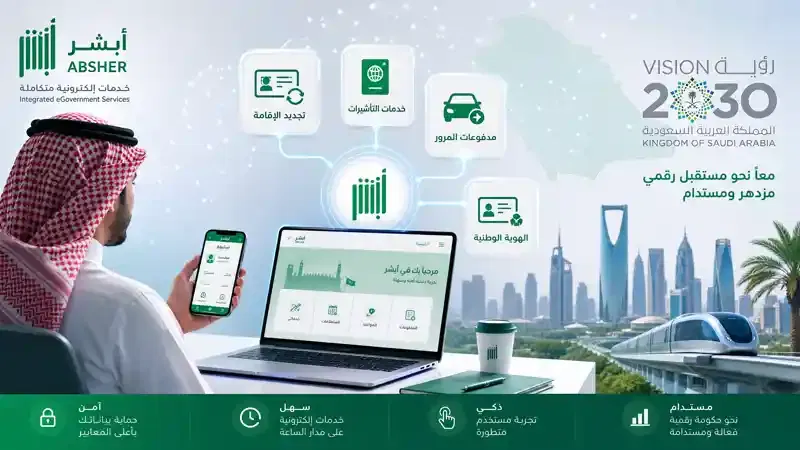
How to Register and Activate Your Absher Account
Accessing Absher services requires a registered and activated account. The process is straightforward but requires adherence to specific security protocols to protect user data and prevent identity fraud.
Step 1: Registration
1.Visit the official Absher website (absher.sa) or download the Absher app from the App Store or Google Play. The app supports both Arabic and English languages, making it accessible to everyone.
2.Select “New User” or “New Registration.”
3.Enter the required basic data: National ID or Iqama number, date of birth, mobile number, and email address.
4.Ensure that the mobile number is registered under the resident’s name and Iqama/National ID number, as this is crucial for receiving One-Time Passwords (OTPs) and verification codes .
5.A confirmation message with a temporary password will be sent to your registered mobile number. You will be prompted to create a secure password during your first login.
Step 2: Account Activation
For full access to all services, the account must be activated. There are several approved methods for activation, designed to accommodate different user preferences and locations:
•Passport Self-Service Kiosks: This is the most common method, available at Passport branches and major commercial centers across the Kingdom. It is mandatory for first-time residents as it enables fingerprint registration, which is used for authentication in various services and at airport borders.
•Bank ATMs: Available through most major Saudi banks. This method requires a fingerprint already registered with the bank. For first-time residents, this method does not work before activating the fingerprint via Passport self-service kiosks.
•Bank Branches or Registration Offices: Users who prefer manual activation or face technical issues with the kiosks can visit a bank branch or a dedicated registration office with their original identification documents for assistance.
Once activated, the user can use Absher as a Single Sign-On (SSO) for all other government platforms, such as Qiwa, Mudad, GOSI, and ZATCA, eliminating the need to create and manage multiple accounts for different government services . This integration is a key feature that simplifies the user experience across the entire digital government ecosystem.
Absher vs. Muqeem vs. Nafaz: Understanding the Differences
Navigating Saudi Arabia’s rapidly evolving digital ecosystem can sometimes be confusing due to the existence of multiple government applications. While they are interconnected, each serves a distinct purpose and is targeted at different user needs.
| Feature | Absher (أبشر) | Muqeem (مقيم) | Nafaz (نفاذ) |
| Primary Purpose | Personal Civil Affairs & Traffic Assistant | Expat Residency & Visa Control | Digital Signature & Legal Authentication |
| Who Needs It | All residents (citizens and expats) | Employers and Sponsors | Business Owners and Professionals |
| Key Function | Renewing Iqamas, paying traffic fines, issuing IDs | Issuing exit/re-entry visas, managing employee borders | Signing contracts, authenticating official documents |
| Security Level | Medium (SMS OTP, Digital ID) | High (Biometric) | Highest (Facial Recognition) |
When to use which?
•Use Absher for your daily personal needs: renewing your Iqama, paying a speeding ticket, or booking a passport appointment.
•Use Muqeem if you are an employer needing to issue an exit/re-entry visa for a foreign employee or report a runaway worker within the legal timeframe.
•Use Nafaz when you need to legally sign a contract electronically, submit official documents to government portals, or approve high-value financial transfers that require robust legal authentication.
Understanding these distinctions is crucial for anyone living or working in Saudi Arabia to ensure they are using the correct platform for their specific administrative tasks.
Benefits of Using Absher Services
The widespread adoption of Absher Services is driven by its undeniable benefits to the Saudi population and the broader economy.
1. Unmatched Convenience and Accessibility
Absher is available 24/7 via its website and mobile application (available in both Arabic and English). Users can access government services from the comfort of their homes, offices, or anywhere in the world, eliminating the need to take time off work to stand in long queues at government offices . This 24/7 availability is particularly beneficial for expatriates who may have limited mobility or time to visit government offices during standard working hours.
2. Time and Cost Efficiency
The platform is designed for speed and simplicity. Most transactions can be completed in just a few minutes. By digitizing these processes, Absher saves citizens and the government immense amounts of time and money. The estimated annual savings of SAR 15 billion in conventional transaction costs is a testament to this efficiency . This efficiency translates to a more productive workforce and a more agile economy.
3. Centralized and Unified Services
Absher acts as a central hub, integrating services from nine different government entities, including the General Directorate of Passports, Civil Affairs, Traffic, Public Security, and the Ministry of Municipalities and Housing . This unification means users do not have to navigate multiple disparate websites; everything they need is in one place, creating a seamless and user-friendly experience.
4. Enhanced Security and Transparency
The platform utilizes robust security measures, including Two-Factor Authentication (2FA) via SMS and biometric verification. Furthermore, the digital nature of the transactions ensures transparency, as users can easily track the status of their requests and access a complete history of their transactions through the Absher Reports service . This transparency builds trust and accountability in government dealings.
5. Seamless Integration with Vision 2030
By adopting Absher, users are directly participating in the realization of Saudi Vision 2030. The platform supports the kingdom’s goal of becoming a digital-first economy, fostering an environment where technology simplifies daily life and accelerates economic growth . It is a tangible example of how digital infrastructure can transform a nation.
Frequently Asked Questions (FAQs)
1. Is the Absher platform free to use?
Yes, registration and the use of the Absher platform are completely free. There are no subscription fees. However, specific government services requested through the platform (such as Iqama renewal or passport issuance) will incur their standard government fees, which can be paid via the SADAD system.
2. Can foreign investors register on Absher?
Foreign investors without Saudi residency cannot directly register with Absher. They typically need a Saudi national or a Saudi resident acting as an authorized representative to manage government transactions on their behalf. Alternatively, they can utilize specialized business setup services to handle these requirements.
3. What should I do if my mobile number is not registered under my Iqama?
It is highly recommended to register your mobile number under your Iqama or National ID. If your number is registered under a passport or another name, you may experience technical issues when renewing your Iqama or receiving verification codes. You can update your mobile number through the Absher website or by visiting a Civil Affairs office.
4. How do I pay for services issued through Absher?
Payments for services are processed through the SADAD electronic payment system. When you complete a transaction on Absher (e.g., renewing an Iqama), an invoice number is generated. You can use this invoice number and the specific biller code for the relevant ministry (e.g., 092 for Passports, 093 for Traffic) to pay via your bank’s app, ATM, or online banking portal.
5. What is the Absher Business platform, and who can use it?
Absher Business is designed exclusively for Saudi sole proprietorships (individual establishments) that have no more than 100 employees. It allows business owners to manage their workforce electronically, including issuing visas, renewing Iqamas, and handling exit/re-entry visas. It is not intended for larger companies or foreign-owned entities.
6. Can I use Absher to book driving school appointments?
Yes, the General Department of Traffic utilizes Absher to manage driving licenses. You can book, modify, or cancel training appointments at authorized driving schools directly through the platform.
7. How does Absher support Digital IDs?
Absher issues Digital IDs that allow users to access a wide range of services provided by the Ministry of Interior. These digital IDs can be used to verify identity without carrying physical cards, and they integrate with the National Single Sign-On system for other government platforms.
Conclusion
Absher Services stands as a monumental achievement in Saudi Arabia’s journey toward a fully digital society. By providing over 460 services to more than 28 million users, it has streamlined bureaucratic processes, saved billions of riyals, and significantly improved the quality of life for citizens, residents, and visitors alike.
Whether you are managing your family’s residency, paying traffic fines, or handling business-related visa issuances, Absher offers a secure, efficient, and user-friendly solution. As Saudi Arabia continues to advance under Vision 2030, the Absher platform will undoubtedly continue to evolve, introducing new features and further enhancing the digital governance experience.
If you are living in or planning to move to Saudi Arabia, familiarizing yourself with the Absher platform is not just recommended—it is essential for navigating daily life smoothly and efficiently. Embrace the digital transformation and let Absher Services simplify your interactions with the government.