
The Ultimate Guide to MOI Absher: Navigating Saudi Arabia’s E-Government Services
The digital transformation of public services in Saudi Arabia has been nothing short of transformative, and at the center of that change stands MOI Absher. MOI Absher is the Ministry of Interior’s flagship electronic platform, designed to deliver seamless, secure and efficient government services to citizens, residents, businesses and government entities across the Kingdom. Whether you are a Saudi national renewing a passport, an expatriate renewing an Iqama, or a business managing regulatory requirements, MOI Absher consolidates hundreds of services into a unified digital experience. This guide explains what MOI Absher is, why it matters, how to register and activate an account, and how to make the most of its individual, business and expatriate services.

In this comprehensive guide we’ll review key features and statistics for MOI Absher, provide step-by-step registration instructions, highlight services specifically for expatriates, compare the web and mobile experiences, discuss recent updates and the platform’s strategic role in Vision 2030, and answer frequently asked questions. Along the way you will learn practical tips that help you use the Absher platform services more effectively and securely.
MOI Absher’s impact on everyday life in Saudi Arabia goes beyond simply replacing in-person interactions. For many users, Absher is the first point of contact with government services: booking appointments, receiving digital permits, or validating identity for third-party services. For example, medical centers and universities increasingly accept Absher-generated certificates and digital IDs for enrollment and verification, reducing administrative delays. In addition to convenience, MOI Absher improves transparency by providing status tracking for submitted requests and generating official electronic receipts that are legally recognized. Whether you are a new expatriate learning the system, a business administrator coordinating workforce compliance, or a family member managing dependent documentation, the Absher platform services are designed to simplify and centralize those tasks.
Security and user education remain priorities. New users should take time to read Absher’s security guidelines, enable all available two-factor options, and keep personal contact information up to date to avoid missed notifications. For administrators and HR teams, integrating Absher processes into company onboarding checklists reduces compliance risk and ensures employees maintain valid Iqamas and travel permissions. Throughout this guide, practical examples and tips will help you navigate both standard and less common scenarios encountered on the Absher platform.
What is MOI Absher and Why Does It Matter?
MOI Absher is the official electronic platform of the Ministry of Interior (MOI), Kingdom of Saudi Arabia. Launched in 2010, the Absher platform has evolved into an integrated digital ecosystem comprising three portals—Individuals, Business and Government—and offers comprehensive public services across multiple sectors. The name “Absher” in Arabic connotes “good tidings” or “yes, done,” reflecting the platform’s emphasis on speed, convenience and responsiveness to user needs.
MOI Absher matters for several reasons:
•Digital consolidation: It centralizes services that once required visits to government offices, enabling citizens and residents to perform transactions online and saving time and travel.
•Security and identity: MOI Absher integrates with national identity systems and authentication mechanisms, including Nafath and unified digital IDs, ensuring secure access and reliable identity verification.
•Economic impact: The platform is estimated to save the Kingdom SAR 15 billion annually through efficiencies and reduced administrative overhead.
•Strategic alignment: MOI Absher supports Saudi Arabia’s Vision 2030 by accelerating e-government transformation and improving public-sector performance and citizen satisfaction.
Absher’s role reaches across sectors such as Passports, Traffic, Civil Affairs, Public Security, Public Prosecution, Prisons, Municipalities, Hajj & Umrah, and Expatriate Affairs. As a core e-government tool, MOI Absher has become essential for residents, visitors and businesses navigating services in the Kingdom.
Beyond these broad benefits, MOI Absher also supports operational continuity and emergency response. During public health incidents or periods of restricted movement, Absher-enabled services—such as digital permits and electronic certificates—help maintain essential transactions without requiring face-to-face contact. For multinational companies and HR service providers, the Absher platform services tie directly into workforce management workflows: scheduling Iqama renewals in advance, bulk processing visa requests via business portals, and automating penalty payments to prevent legal complications. In short, MOI Absher is not only a tool for individual convenience; it is a backbone of administrative efficiency and regulatory compliance across the Kingdom.
Key Features and Statistics of the MOI Absher Platform
The scale and reach of MOI Absher reflect the Kingdom’s aggressive push toward digital public services. By 2025 the platform had achieved several major milestones:
•Three portals: Individuals, Business and Government, each tailored to user needs and offering specific workflows and administrative tools.
•User and identity scale: More than 28 million unified digital IDs issued and over 20 million registered users. In total, the platform served 32 million+ individuals and 1.8 million+ businesses by 2025.
•Transaction volume: Over 448 million electronic transactions in 2025 alone, demonstrating high utilization across services.
•Efficiency gains: An estimated annual cost savings of SAR 15 billion, achieved by reducing manual processes, paperwork, and physical service centers.
•Global ranking: Saudi Arabia ranked 4th globally and 1st regionally in the Digital Services Index, reflecting the maturity of platforms like MOI Absher.
•Continuous expansion: Over 460 services across the three Absher platforms as of 2025, with new services regularly added to meet evolving user needs.
Key feature highlights of MOI Absher include:
•Unified digital ID and Nafath integration for secure authentication.
•Multi-channel access via web and native mobile apps (Android and iOS).
•Role-based portals (individual, business, government) for tailored services.
•Real-time notifications for service updates, document status, and violations.
•Multilingual support with Arabic and English interfaces for broader accessibility.
•Self-service kiosks and bank-based activation channels to complete identity verification.
MOI Absher’s scale and suite of features make it a central pillar of Saudi Arabia’s e-government architecture, and understanding its capabilities is critical for anyone living, working or doing business in the Kingdom.
Practical implications of these features are noticeable at both the individual and institutional levels. For example, real-time notification capabilities mean a user will receive an SMS or push alert when their passport renewal application is processed or when a traffic violation is recorded—reducing uncertainty and preventing overlooked obligations. Business users benefit from the Absher business portal’s ability to manage company-level approvals, sponsor employee visas in bulk, and access transaction histories for audits. Additionally, integration with banking channels not only speeds activation but also ties seamlessly into fee payments and payroll reconciliations where employer-paid services are involved. For government administrators, consolidated logs and analytics derived from Absher transactions help prioritize service improvements and detect system-wide issues quickly. These practical outcomes explain why Absher is considered one of the most impactful public-sector digital solutions in the region.
Comprehensive List of MOI Absher Services for Individuals
MOI Absher offers a wide array of services for individuals organized by sectors. Below is a detailed breakdown of core service categories and the most commonly used individual services on the Absher platform.
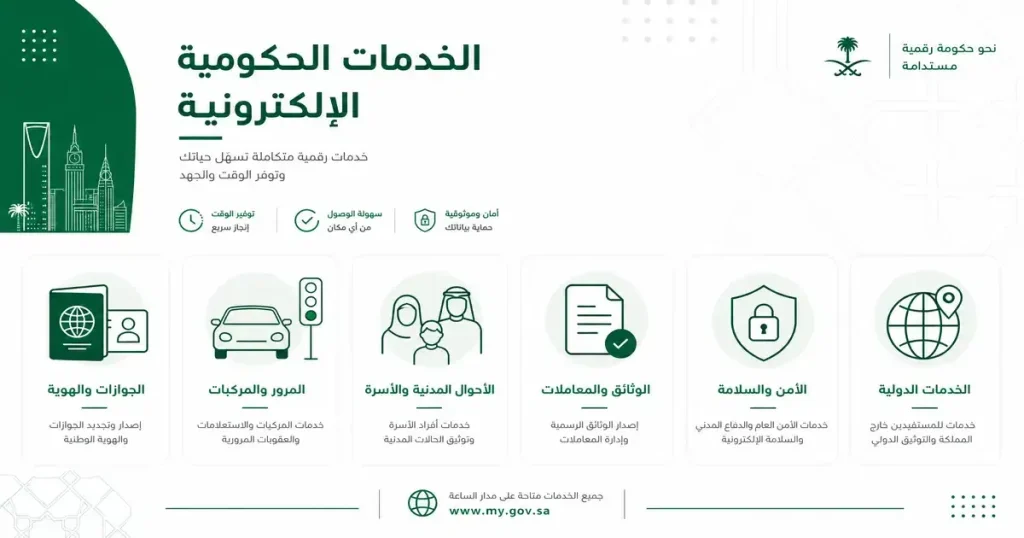
Passports and Travel Services
•Passport issuance and renewal for Saudi nationals.
•Electronic passport status tracking.
•Travel permit services for minors and other dependent-related travel authorizations.
•Exit and re-entry visa issuance and validation (for expatriates via the relevant expat portal).
•Digital visitor card introduced in 2025/2026 to streamline short-term visit entries and reporting.
Many users rely on MOI Absher for step-by-step passport processes. For instance, passport renewal typically involves uploading required supporting documents, paying the applicable fees through an integrated payment gateway, and scheduling an appointment if biometric capture is required. The system will notify you about the expected processing time and provide a digital receipt that can be used for follow-up or appeals. For family travel, the travel permit service allows parents to issue digital permissions for minors, simplifying airport checks and reducing paperwork for cross-border travel.
Traffic and Vehicle Services
•Payment and settlement of traffic violations and fines.
•Vehicle registration renewal and status checks.
•Driving license issuance, renewal and replacement services.
•Traffic accident reporting tools and electronic submittal of required documents.
•Vehicle transfer and ownership documentation.
Traffic services are especially popular. A common scenario: after receiving a traffic violation, a user logs into Absher, views the violation details, pays the fine online, and stores the electronic receipt for proof of payment. Vehicle owners can also renew registration by confirming insurance validity and completing payment, sometimes in minutes. For accidents, Absher’s reporting tool guides users through submitting photos, location details, and witness statements, which helps speed insurance claims and police follow-up.
Civil Affairs
•Civil registry services, including birth, death and marriage records.
•Issuance of national ID-related services and unified digital ID management.
•Updating personal details, civil status and family records.
•Issuance of electronic certificates and attestations.
Civil Affairs services through Absher are increasingly integrated with hospitals and municipalities. For example, birth registrations can be linked directly from participating hospitals to speed up the issuance of birth certificates and avoid multiple visits. Electronic certificates issued via Absher carry official seals and can be downloaded as PDF documents suitable for use across public and private sector workflows.
Expatriate Affairs and Residency Services
•Iqama (residency permit) issuance, renewal and replacement services.
•Transfer of sponsorship and employment-related approvals.
•Exit/re-entry visa issuance and cancellation.
•Renewing resident ID for family members outside the Kingdom (a new service added in 2025/2026).
•Services that facilitate expatriate compliance with labor and residency regulations.
For expatriates, MOI Absher reduces the friction of residency management. Iqama renewals typically require employer-side initiation, confirmation of no outstanding violations, and fee payment—steps that Absher coordinates with the Ministry of Human Resources and Social Development and related authorities. The platform also stores historical data such as prior visa types and sponsorship records, which can be useful when preparing for status changes or legal verifications.
Public Security and Legal Services
•Filing complaints and following up on public prosecution cases.
•Access to certain legal notices and case-related electronic interactions.
•Coordination and updates with Public Security and Prisons sectors where necessary.
Legal and security services on Absher allow users to follow up on criminal complaints, request police reports, and receive electronic notifications about case progress. Users also can grant lawyers or legal representatives limited access where appropriate, simplifying legal follow-ups.
Hajj & Umrah Services
•Pilgrim and Umrah-related services such as permit issuance, scheduling and coordination with Hajj & Umrah authorities.
•Integration with other platforms for health and travel validations as required during pilgrimage seasons.
During high-demand seasons such as Hajj, Absher helps distribute permits, validate health credentials, and coordinate accommodation and transportation logistics. Pilgrims can receive step-by-step guidance tied to their permit status, immunization requirements, and transportation schedules.
Municipal and Community Services
•Services tied to municipal approvals, applications for permits, and community policing initiatives.
•E-notifications for local governance matters and document submissions.
Municipal services handle tasks like building permits, business signage approvals, or community event permits. Absher’s integration reduces the paperwork required at municipal counters and allows citizens to track approvals and inspections online.
Popular Individual Services on MOI Absher
Among the hundreds of services available on the Absher platform, several stand out as particularly popular or essential:
•Renewing Iqama (residency permit) — a daily necessity for expatriates.
•Digital ID management and unified digital ID issuance.
•Traffic violation look-up and payment — widely used by drivers across the Kingdom.
•Passport renewal for Saudi nationals.
•Exit/re-entry visa requests and extensions.
•Renewing resident ID for family members outside the Kingdom — a critical new service for families separated by travel.
Practical tip: create a simple calendar reminder for recurring actions like Iqama renewal or vehicle registration to avoid penalties. Many users also link their Absher account with trusted family members or HR representatives (using Absher’s delegated access features where allowed) to ensure critical deadlines are not missed.
Recent Service Additions (2025/2026)
MOI Absher continues to expand based on user needs and policy updates. Recent additions include:
•Four new digital services for residents and dependents introduced in 2025/2026 to improve family and dependent care management.
•A Digital visitor card launched to streamline short-term visits and enhance monitoring and facilitation of visitor-related processes.
•Renewing resident ID for family members outside the Kingdom, enabling families to manage IDs without the physical presence of the member inside Saudi Arabia.
Additionally, Absher has been piloting expanded interoperability with private sector platforms—for example, allowing verified Absher digital IDs to be used for bank account opening or telecom service activation. These integrations reduce repetitive identity checks and speed customer onboarding across sectors.
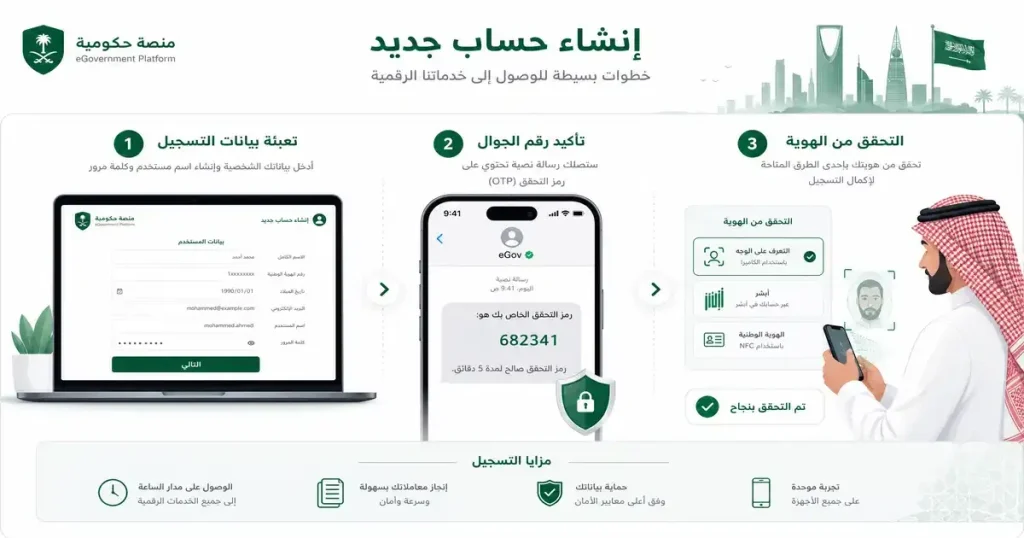
Step-by-Step Guide: How to Register and Activate an MOI Absher Account
Registering for MOI Absher and activating your account are essential first steps to accessing the platform’s secure services. Below is a detailed walkthrough from account creation to activation, including common troubleshooting tips.
Step 1 — Create Your Account (Individuals)
1.Visit the official MOI Absher website or download the Absher app (available on Android and iOS).
2.Select the Individuals portal (or Business/Government if applicable).
3.Click “Register” or “New User” and choose whether you are a Saudi national or an expatriate.
4.Enter your official identity details: National ID or Iqama number, full name, date of birth and other requested fields.
5.Provide a valid mobile phone number (a local Saudi number is preferred for SMS OTP delivery) and a valid email address.
6.Choose a strong password that meets the platform’s complexity requirements (typically a minimum length and mix of characters).
7.Accept terms and privacy policy and submit the registration form.
Step 2 — Verify Your Identity (OTP and Verification)
1.After submission, you will receive a one-time password (OTP) via SMS to the registered mobile number.
2.Enter the OTP on the registration page to validate your mobile number.
3.A verification email may also be sent; follow any required email confirmation steps.
Step 3 — Activate Your Account (Two Primary Methods)
Activation binds your online absher credentials to your official identity and allows you to perform sensitive operations.
Activation Method A: Self-Service Activation Machines
•MOI and partner locations across the Kingdom provide self-service kiosks.
•Visit a self-service machine with your ID card or Iqama and follow the on-screen steps to scan or input your ID number.
•The machine will complete the activation by verifying your identity and associating the online account with your real-world identity.
Activation Method B: Bank-Based Activation
•Many Saudi banks support Absher account activation via their branches or digital channels.
•Present your official ID or Iqama to the bank branch and request activation for Absher.
•Banks will verify your identity using their existing KYC records and complete the Absher activation process.
Step 4 — Confirm and Complete
•After activation, log into MOI Absher with your credentials.
•Enable additional security such as two-factor authentication (via SMS, Nafath or other methods) to increase account safety.
•Review your profile and update any contact details as needed.
Troubleshooting Common Registration and Activation Issues
Issue: No OTP Received
•Ensure the mobile number provided is correct and active.
•Verify there is mobile network coverage and SMS delivery is not blocked by your service provider.
•Request a new OTP after waiting a few minutes. If still not received, try an alternative mobile number or contact Absher support.
Issue: Password Policy Rejected
•Review the password requirements: length, character variety (upper/lowercase, digits, symbols).
•Avoid easily guessed passwords and do not reuse passwords across multiple sites.
Issue: Activation Fails at Self-Service Kiosk
•Ensure your ID or Iqama is valid and not expired.
•Try another authorized activation location or use the bank activation channel.
•If repeated failures occur, contact MOI Absher support for assistance.
Issue: Account Locked After Multiple Failed Login Attempts
•Use the password recovery or unlock option on the Absher login page.
•Follow the identity verification steps to reset your password and unlock the account.
Best Practices for Account Security and Long-Term Use
After activation, treating your MOI Absher account like any critical digital identity is important. First, enable Nafath or biometric login where available to reduce dependency on passwords. Register multiple contact methods (mobile and email) so OTPs and critical alerts reach you even if you change numbers.
Avoid sharing account credentials; if you must delegate tasks to HR or family members, use Absher’s official delegation features rather than sharing passwords. Periodically review your transaction history and notification logs for any unfamiliar activity—Absher logs are designed to help spot potential identity misuse early. Finally, when using public or shared devices, always log out and avoid saving passwords in the browser.
Navigating the MOI Absher Website and Mobile App
MOI Absher is available as a web portal and as a mobile application, each optimized for different user preferences while offering the same core services. Understanding their differences can improve your experience.
Web vs. Mobile App Experience
The Absher platform provides a consistent service catalog across the web and mobile channels, but the experience varies:
•Web portal (Absher.sa): Best for users who prefer larger screens and need to print documents, upload files, or perform multiple, complicated transactions. The web interface provides full access to all Absher platform services and is helpful for in-depth tasks such as downloading official certificates or generating detailed service reports.
•Mobile app: Designed for convenience and speed, the Absher mobile app offers push notifications, biometric login (fingerprint or Face ID), and an optimized flow for everyday tasks like renewing a traffic fine payment, checking Iqama status, or requesting an exit/re-entry visa. The app is frequently updated and supports offline caching for select features.
Language Options
MOI Absher caters to a diverse audience. The platform supports Arabic and English language options on both the website and mobile app (Absher Saudi Arabia), enabling expatriates and non-Arabic speakers to navigate services such as Absher expat services with greater ease.
Security Features
Security is a cornerstone of the MOI Absher experience. Key safeguards include:
•Nafath integration: Absher uses Nafath (the national single sign-on) for secure identity authentication and central access control across government platforms. This integration minimizes repeated credential entry and leverages centralized identity management.
•Unified digital ID: MOI Absher supports unified digital IDs, which provide verified digital identities used across multiple services. Over 28 million unified digital IDs have been issued, ensuring secure and trusted transactions.
•Two-factor authentication: OTPs and biometric options add a second layer of protection beyond your password.
•Encryption and transaction logging: All sensitive data exchanges are encrypted, and the platform maintains logs of actions and notifications to help users detect suspicious activity.
Tips for Efficient Navigation and Faster Transactions
1.Use a desktop for complex tasks: If you need to upload multiple documents or download certified PDFs, complete those steps on the web portal where file management and printing are easier.
2.Keep the mobile app updated: App updates often include important security patches and new service features that improve speed and reliability.
3.Save commonly used workflows: On the web interface, bookmark frequently used pages (for example, Iqama renewal or vehicle services). The mobile app allows you to add quick-access shortcuts on the home screen for faster transactions.
4.Use notifications wisely: Enable push notifications for critical alerts (Iqama expiry, passport readiness, traffic violations) but manage non-essential alerts to reduce notification fatigue.
5.Keep documents in standard formats: Absher accepts common file formats (PDF, JPG). Ensure scanned documents are clear and within size limits to avoid upload failures.
6.Use a stable internet connection for large uploads: For documents requiring high resolution (passport scans or medical records), a stable Wi-Fi connection reduces the chance of interruption or corruption.
Accessibility and user support have also improved: the Absher app supports larger text sizes and screen reader compatibility on modern mobile operating systems, and help sections provide step-by-step instructions with screenshots for many services. For organizations, the business portal supports role-based access control so HR staff can grant limited administrative rights without exposing full account credentials.
MOI Absher for Expatriates: Essential Services You Can Access
MOI Absher is indispensable for expatriates living and working in Saudi Arabia. The platform simplifies many interactions that previously required in-person visits to government offices.
Key Expat Services on MOI Absher
•Iqama renewal: Renewing a resident permit (Iqama) is one of the most-used services on Absher. The platform guides the sponsor and the expatriate through the renewal process, payment of fees, and issuance of updated Iqama details.
•Exit/Re-entry and final exit visas: Sponsors can issue or cancel exit/re-entry visas, and expatriates can check status and validity through their Absher profiles. Final exit visas and return permissions are similarly handled through the platform.
•Change or transfer of sponsor: Some aspects of changing an employer or transferring sponsorship are facilitated through Absher expat services in coordination with the Ministry of Human Resources and Social Development and other stakeholders.
•Dependent services: Recent updates allow renewing resident ID for family members who are outside the Kingdom, simplifying family reunification and document maintenance.
•Digital visitor card: New services introduced in 2025/2026, such as the Digital Visitor Card, help expatriates and visitors manage temporary stays or visits with fewer in-person steps.
•Fines and traffic services: Expatriates can pay traffic fines, check vehicle registration status, and request traffic-related services via Absher individual services.
•Reporting and complaints: Absher provides channels for reporting issues such as absconding workers or submitting general complaints to public security authorities.
How MOI Absher Simplifies Life for Foreign Workers
For foreign workers, MOI Absher reduces administrative friction and travel time by centralizing services online. Tasks that once required multiple office visits are now completed within minutes, backed by secure verification and digital receipts. The platform helps expatriates maintain legal status, access sponsor services, and manage family documentation efficiently.
Practical example: An expatriate whose Iqama is due for renewal will usually see the process initiated by the sponsor company. The employer verifies no outstanding fines, pays renewal fees through the business portal or linked banking services, and schedules electronic issuance of the new Iqama details. The expatriate receives an automated notification and a digital Iqama card that can be shown when required.
If a family member is abroad, the new “renew resident ID for family members outside the Kingdom” workflow allows the sponsor or family head to complete the renewal online, upload required documents (such as passport copies and prior Iqama details), and receive a digitally signed certificate for use in consulate processes.
Timelines and fees vary by case: standard Iqama renewals are typically processed within days but can take longer if additional clearances are needed (for example, unpaid fines or medical clearance). Users should check specific service pages on Absher for fee schedules and expected processing times. Employers managing multiple expatriate workers often use the business portal to batch tasks and schedule renewals in advance to avoid last-minute legal complications.
The Future of E-Government: MOI Absher and Vision 2030
MOI Absher stands at the center of Saudi Arabia’s digital transformation and Vision 2030 goals to modernize government services and improve quality of life. The platform’s evolution since its establishment in 2010 reflects the Kingdom’s ambition to lead the region and compete globally in public digital services.
Global and Regional Recognition
Saudi Arabia’s investment in digital infrastructure has earned global recognition. The Kingdom ranked 4th globally and 1st regionally in the Digital Services Index, a testament to efforts driven by MOI Absher and other government platforms.
Ongoing Expansion and Innovation
•Service growth: As of 2025, the Absher ecosystem offers over 460 services across Individuals, Business, and Government platforms, serving more than 20 million users and 32 million+ individuals with 1.8 million+ businesses registered.
•Transaction scale: With more than 448 million electronic transactions in 2025 and estimated annual savings of SAR 15 billion, MOI Absher has already transformed public administration.
•New services: Continuous updates such as the addition of four resident and dependent services in 2025/2026, digital visitor cards, and the ability to renew resident IDs for family members abroad show the platform’s commitment to expanding user-centric capabilities.
Looking ahead, MOI Absher’s roadmap includes deeper use of AI and data analytics to personalize services and predict user needs—such as automatic reminders for renewals or recommending the most efficient service channel. Expect expanded APIs and cross-government interoperability that will allow private sector services (like banking, insurance, and utilities) to authenticate users through the unified digital ID, reducing duplication of KYC processes.
International cooperation on digital identity frameworks may enable secure, standardized validation of Saudi-issued digital IDs abroad, improving mobility for citizens and residents. Overall, MOI Absher’s continuous evolution will play a critical role in achieving Vision 2030 objectives for a diversified, tech-enabled public sector.
Frequently Asked Questions (FAQs) about MOI Absher
What is MOI Absher?
MOI Absher is the official electronic platform of the Ministry of Interior in the Kingdom of Saudi Arabia that provides Individuals, Business, and Government services online. Established in 2010, MOI Absher offers hundreds of digital services, from passports and traffic to expatriate affairs and civil affairs.
How do I register for MOI Absher?
To register, visit or download the Absher app, choose Individuals, enter your National ID or Iqama number and issuance number, provide a Saudi mobile number and email, create a secure password, and verify with the OTP sent to your phone.
How do I activate my MOI Absher account?
After registration, activate your account using self-service machines at Jawazat offices, participating bank branches, or MOI service centers. Activation links your digital account to your official identity and unlocks full platform functionality.
Can expatriates use MOI Absher?
Yes. Absher expat services allow expatriates and their sponsors to renew Iqamas, issue exit/re-entry visas, manage dependent services, pay fines, and access many other services relevant to residents.
What is Nafath and how does it relate to MOI Absher?
Nafath is Saudi Arabia’s national single sign-on and identity service. MOI Absher integrates with Nafath to provide secure authentication and centralized identity management for government services.
What should I do if I forget my MOI Absher password?
Use the “Forgot Password” link on the Absher login page. You will verify your identity with OTP and follow steps to reset your password. If you face difficulties, visit an activation center or contact Absher support.
How secure is MOI Absher?
MOI Absher uses multiple security layers including encryption, OTP two-factor authentication, Nafath integration, unified digital IDs, and transaction logs. Users should also enable biometric logins and maintain strong passwords.
Are MOI Absher services available in English?
Yes. The Absher platform supports both Arabic and English to accommodate residents and expatriates.
Can I use MOI Absher services from outside Saudi Arabia?
Some services are available internationally, but certain transactions may require in-Kingdom activation or verification. For specific expatriate services like renewing a resident ID for family members outside the Kingdom, MOI Absher has introduced dedicated digital workflows.
Where can I get help if I encounter problems with MOI Absher?
Visit official MOI Absher help pages on Absher.sa, consult the Nafath portal, contact customer support through the app, or visit a Jawazat or MOI service center for in-person assistance.
What is the Digital Visitor Card?
The Digital Visitor Card is a recent MOI Absher service designed to streamline short-term visits and related administrative tasks for visitors to Saudi Arabia. It allows authorities and hosts to manage visitor information more effectively while improving the visitor experience.
How many services are available on MOI Absher?
As of 2025, MOI Absher provides over 460 services distributed across the Individuals, Business, and Government portals. New services continue to be added in response to user needs and policy objectives.
How do I pay fines and fees on MOI Absher?
The Absher platform supports electronic payments via integrated payment gateways and linked bank services. Users can view outstanding fines and fees within their account dashboard and complete payments online.
How many users does MOI Absher have?
By 2025, the Absher platform had over 20 million registered users, and more than 28 million unified digital IDs were issued. The platform supports 32 million+ individual profiles and 1.8 million+ business accounts.
How do I link my Absher account to my Saudi bank?
Many major Saudi banks provide an Absher activation and linking service. Visit your bank’s branch or use its digital banking app to find the Absher linkage option. The bank will verify your identity using its records and then complete activation or link your account, which can speed payment of fees directly from your bank account when using Absher services.
Can businesses use MOI Absher to manage employees?
Yes. The Business portal on MOI Absher is specifically designed to help companies manage employee sponsorships, renewals, and visa-related services. HR departments can use role-based access to process multiple employee transactions, pay fees, and generate reports for compliance and audit purposes.
Conclusion
MOI Absher has redefined how citizens, residents, and businesses in Saudi Arabia interact with government services. As the core digital gateway for Ministry of Interior services ranging from passports and traffic to expatriate affairs and civil services, MOI Absher delivers convenience, security, and efficiency that align with Vision 2030 objectives.
Whether you are a Saudi national or an expatriate, registering and activating an MOI Absher account will save time, reduce bureaucracy, and provide secure access to hundreds of vital services. For step-by-step support and the latest updates on Absher platform services, visit Absharsa.com to find guides, news, and practical tips tailored to users across the Kingdom.
As MOI Absher continues to evolve, staying informed about new features, policy changes, and integration opportunities will help individuals and organizations extract the most value from the platform. Bookmark official channels, enable notifications, and include Absher-related tasks in routine compliance checks to avoid lapses in residency or licensing.
For business users, consider integrating Absher touchpoints into HR systems and onboarding checklists to automate recurrent administrative tasks. For expatriates and families, use the platform’s delegated features and the recent capabilities for managing dependent IDs abroad to maintain continuity without unnecessary travel. If in doubt, always consult the official MOI Absher help resources or visit designated activation centers to ensure your account and documentation meet the Kingdom’s regulatory requirements.